

Vietnam — felt, not toured.
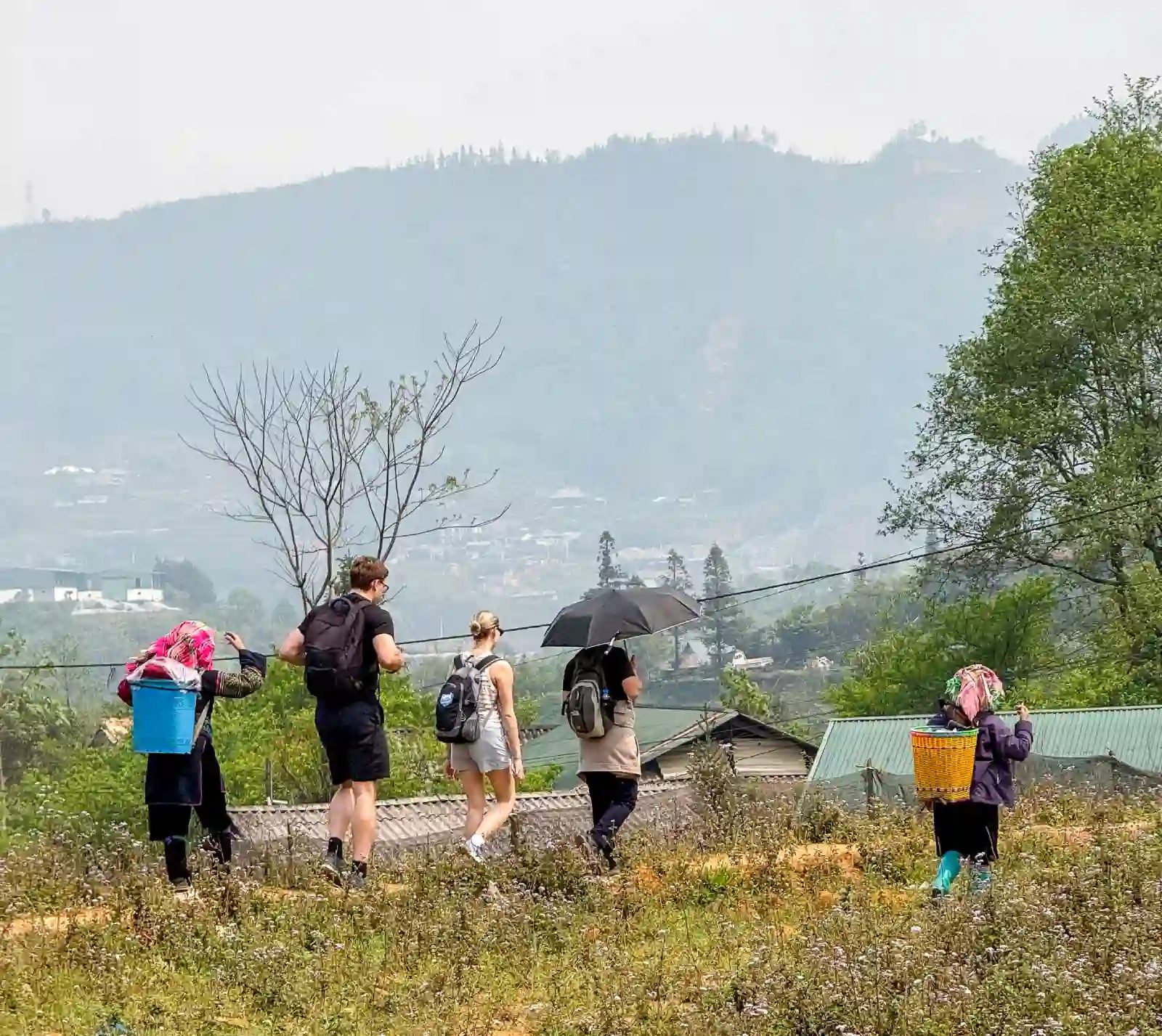
Sapa Countryside Walking Tour
The valleys below Sapa Town. Most visitors never find the way down.
A half-day private guided walk from Sapa Stone Church through Suoi Ho and Ma Tra Valley — village trails, a Black H'mong indigo weaving visit, the iron bridge, and a hidden footpath that ends at a café above Muong Hoa.
The Stone Church marks the beginning. From there, the path leaves the town behind — past the lake, through the village trails, down into a landscape that operates entirely on its own terms. Rice terraces stepping toward a stream. A Black H'mong home with indigo drying in the yard. A hidden footpath through the Ma Tra Valley that only walkers know about.
This is not a mountain trek. It is a half-day walk through the cultural and agricultural heart of the Sapa highlands — unhurried, accessible, and quietly extraordinary.
Three things that make this tour different.
PRIVATE
Private guided walk at your own pace — no rush, no crowds, no shared group.
GUIDED
Experienced local guide throughout, safe village routes, and clear briefing before departure.
LOCAL
Led by Sapa-based guides who know these valleys, families, and seasonal rhythms through daily life.
How the day unfolds.
- STARTStep 01Sapa Stone ChurchSapa Town centre
A French colonial landmark that has stood in the town centre since 1895. Your guide begins here — the history of the building, the ethnic markets that still gather nearby, the Sapa that existed before the cable cars arrived. A grounding before the walk begins.
- SAPA LAKEStep 02Sapa Lake → Suoi Ho VillageSapa Lake · Suoi Ho
The path follows quiet village trails past the lake and down toward Suoi Ho — gentle descent, rural concrete paths giving way to earth, the terraces appearing on both sides. The transition from town to countryside happens quickly and completely.
- SUOI HOStep 03Black H'mong VillageSuoi Ho · traditional H'mong home
A traditional H'mong community at the edge of the terraced valley. Visit a local home, observe the hemp weaving and indigo dyeing process when the season allows, and hear your guide explain what the textile patterns carry in terms of identity, status, and community history. This is not a cultural performance. It is a household that has agreed to receive guests.
- THE BRIDGEStep 04Rice Terraces & The Iron BridgeTerraced fields · iron bridge above the stream
The route continues through postcard terraced fields — flooded mirrors, vivid green, or gold depending on the month — crossing a small iron bridge above the stream. Water buffalo. Mountain houses. The sound of irrigation water moving between the levels.
- MA TRAStep 05Ma Tra Valley — The Hidden FootpathMa Tra Valley · narrow walking trail
The walk's most private section: a narrow trail through the valley used almost exclusively by people on foot. Seasonal gardens line the path. The landscape is domestic and extraordinary at once — the kind of countryside that makes visitors reconsider what they thought a famous destination would look like.
- ENDStep 06Scenic Café Above Muong Hoa ValleyCafé overlooking Muong Hoa Valley
The walk concludes at a café with a panoramic view over the Muong Hoa Valley. Coffee, the view, and time to ask your guide about anything else worth seeing in the area. A natural ending that doesn't feel rushed.
Everything that matters. Nothing that doesn't.
Led by Sapa-based guides who know these valleys, families, and seasonal rhythms through daily life.
Included
- ●Private Saigon Travel Mate guide throughout
- ●Full circular walking route — Stone Church to Ma Tra Valley
- ●H'mong village visit with cultural context
- ●Indigo weaving demonstration when season permits
- ●Cultural commentary on textiles, terraces, highland daily life
- ●All village entrance fees
- ●Flexible pace, many natural rest stops
Not included
- ✕Return transport to Sapa Town (available and affordable — paid directly to the driver, separate from the tour)
- ✕Meals and personal expenses
- ✕Travel insurance
- ✕Tips for your guide
- Terrain
- Village paths and rural trails
- Fitness
- Light to moderate. No steep mountain climbing — mainly rural paths and village trails with two to three short uphill sections of a few dozen metres each. The route is mostly gentle downhill and manageable at a relaxed pace. Suitable for healthy seniors who walk regularly and children from age six. Not recommended for people with limited mobility or heart conditions.
- ●Bring · Good walking shoes (the path becomes slippery in rain) · Light rain jacket · Sun hat · Insect repellent · Drinking water
- ●Meeting point: confirmed via WhatsApp after booking
Honest, practical answers.
Fitness+
Light to moderate. No steep mountain climbing — mainly rural paths and village trails with two to three short uphill sections of a few dozen metres each. The route is mostly gentle downhill and manageable at a relaxed pace. Suitable for healthy seniors who walk regularly and children from age six. Not recommended for people with limited mobility or heart conditions.
Distance & Time+
Approximately 4–4.5 km over 2 hours 45 minutes, with plenty of natural breaks for photography and village visits.
What to Bring+
Good walking shoes (the path becomes slippery in rain), light rain jacket, sun hat, insect repellent, drinking water. Children must be supervised at the iron bridge crossing.
The Seasons+
May–June → flooded terraces, mirror reflections. July–September → lush green valley at its most vivid. September–October → golden harvest season. November–March → mist, cold air, atmospheric quiet. Strawberry and artichoke gardens: most abundant in cooler months.
Photography+
The route offers almost no vehicle traffic — you can stop anywhere, at any moment, without disrupting anything. Your guide knows the angles that work and when the light is worth waiting for.
The Weaving Visit+
Seasonal and genuine. If the harvest period means the indigo process is not active during your visit, your guide provides the full cultural context from inside the home itself. Either version is worth having.
Return Transport+
Return transport to Sapa Town is available and affordable — paid directly to the driver, separate from the tour. Recommended: the return is mostly uphill. Discuss your preference with your guide before departure.
The valleys below Sapa Town. Most visitors never find the way down.
Reserve your place. We handle everything else.